
Pakistani Astronaut Muhammad Zeeshan Ali Slated for Launch to China’s Tiangong Space Station
JIUQUAN, China — The China Manned Space Agency announced on Tuesday the crew for its upcoming Shenzhou-24 human spaceflight mission, confirming that 40-year-old Pakistan Air Force pilot Muhammad Zeeshan Ali will fly to China’s Tiangong space station as a payload specialist.
Ali will become the first Pakistani citizen to travel into orbital space and the first foreign national to board the Tiangong orbital outpost. The flight also marks the inaugural joint mission pairing Chinese and foreign astronauts in the history of China’s crewed space exploration program.
The Shenzhou-24 spacecraft is scheduled to lift off atop a Long March-2F carrier rocket from the Jiuquan Satellite Launch Center in northwestern China at 8:18 a.m. Beijing time on Wednesday, November 25, 2026. That corresponds to 00:18 GMT and 5:18 a.m. Pakistan Standard Time.
Ali will fly alongside two Chinese astronauts: mission commander Tang Hongbo and flight engineer Wu Yi. Tang, an experienced taikonaut, will oversee the mission, while Wu will manage the technical systems of the Shenzhou capsule and station interfaces.
Following launch and successful orbital insertion, the Shenzhou-24 spacecraft is programmed to conduct a rapid autonomous rendezvous sequence lasting approximately three and a half hours. The automated maneuver will culminate in the capsule docking at the forward port of the Tianhe core module, the central living and control hub of the multi-module Tiangong complex.
Once aboard, Ali is scheduled to spend approximately one week conducting a focused experimental curriculum alongside the resident crew. His work will center on four joint China-Pakistan scientific research projects spanning the fields of biotechnology and advanced materials science. Following the completion of his weeklong orbital itinerary, Ali will return to Earth aboard the Shenzhou-23 spacecraft, which is currently docked at the orbital station.
The mission represents the culmination of formal bilateral aerospace agreements established between Beijing and Islamabad. The flight stems directly from an intergovernmental spaceflight cooperation pact signed between the China Manned Space Agency and Pakistan’s Space and Upper Atmosphere Research Commission in February 2025. The flight also coincides with the 75th anniversary of the establishment of formal diplomatic relations between China and Pakistan.
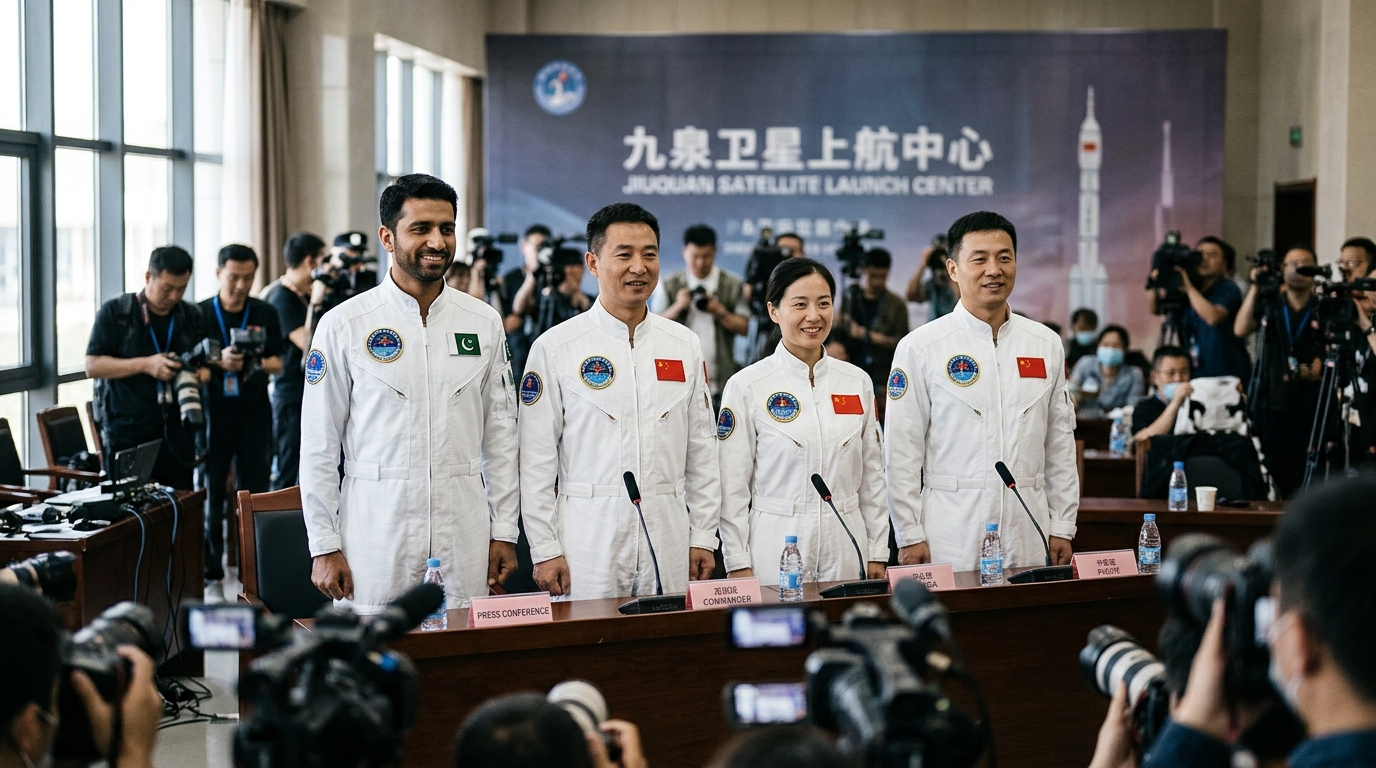
During a pre-launch press conference held Tuesday at the launch base in Jiuquan, Ali appeared in uniform alongside his crewmates and addressed reporters in Urdu, Mandarin, and English.
“I carry the name of Pakistan on my shoulder, the hopes of 250 million Pakistanis,” Ali said. Speaking directly to younger generations back home, he added: “To every child who is watching while I am in orbit, just look up at the sky and remember that I am up there with your dreams.”
Chinese space officials emphasized the broader cooperative foundation that underpinned the flight selection. Speaking at the Jiuquan briefing, China Manned Space Agency spokesperson Zhang Jingbo stated that the mission represents another milestone in bilateral cooperation between the two nations, noting that Pakistan remains China’s “all-weather strategic cooperative partner.”
The mission highlights China’s expanding international engagement through its Tiangong platform, which has operated in low Earth orbit with regular crew rotations since its initial assembly was completed. By including foreign researchers and mission specialists on active flights, the agency has initiated a new phase of international collaboration aboard its national space station.